
Division of Crop Improvement
Introduction
The Crop Improvement Division was established in the VIII Plan when the Directorate of Pulses Research attained the status of Indian Institute of Pulses Research on 5th September 1993. However, research efforts on breeding improved varieties of pulses were initiated with the establishment of Directorate on Pulses Research in 1984. The Division encompasses a broad range of activities from basic studies on plant genomes to development of improved varieties. The Division includes plant breeding, genetics & cyto-genetics and molecular breeding till 2012. In addition, plant genetic resource management / utilization and quality seed production are integral parts of the Division. The mandate crops are chickpea, pigeonpea, mungbean, urdbean, lentil, fieldpea, rajmash, lathyrus, cowpea, mothbean and horsegram.
Thrust areas:
- Exploitation of heterosis in pigeonpea
- Genetic enhancement through pre-breeding
- Development of suitable plant types for different agro-ecological conditions
- Genomics-enabled improvement of pulse crops
- Breeding for tolerance to biotic and abiotic stresses
- Breeding for improved quality
- Plant genetic resources management and utilization
- Maintenance breeding, breeder seed production and seed research
Crop wise priority areas:
Chickpea:
- Genetic enhancement and pre-breeding for yield enhancement and broadening the genetic base of modern cultivars.
- Pyramiding of genes conferring resistance to fusarium wilt and dry root rot through integrated plant breeding approach).
- Development of heat and moisture stress tolerant varieties (QTLs identification for drought, mechanism of heat tolerance etc.).
- Development of chickpea varieties suitable for mechanical harvesting and post emergence herbicide tolerance.
- Genetic enhancement for nutritional quality, grain quality, milling and processing attributes.
Pigeonpea:
- Exploitation of heterosis and development of commercial CMS based hybrids.
- Development of improved varieties (early- and long-duration) possessing resistance to major biotic and abiotic stresses, and genetic enhancement through pre-breeding in long duration pigeonpea.
- Identification and utilization of novel genetic diversity through pre-breeding in long duration pigeonpea.
Urdbean:
- High yielding varieties with sympodial bearing (soybean type), green or black seeds, possessing resistance against yellow mosaic virus and Cercospora leaf spot.
- Development of high yielding varieties for spring/summer seasons, that show resistant to MYMIV/MYMV and Cercospora leaf spot.
Mungbean:
- Genetic improvement for grain yield and multiple biotic and abiotic stress resistance
- Development of medium-short duration and pre-harvest sprouting tolerant mungbean varieties with multiple disease resistance for kharif season.
Lentil:
- High yielding varieties with multiple disease resistance to Wilt, rust and Stemphylium blight.
- Combining higher biomass and early maturity for rice-fallow and utera cultivation.
Field pea:
- Varietal improvement by combining higher biomass, stiff stem and few leaflets traits besides powdery mildew and rust resistance.
- Incorporating resistance to powdery mildew and rust in varieties.
Cowpea:
- Development of high-yielding, short-duration, multi-purpose, and multiple stresses resistance genotypes
Rajmash:
- Development of high-yielding, multiple stress resistant and nutrient-rich rajmash cultivars for diverse agro-ecologies
Mothbean:
- Collection, conservation and characterization of germplasm
- Deployment of mutation breeding for generating variability and high yield
Horsegram:
- Collection, conservation and characterization of germplasm
- Breeding for grain type, DT, synchronous maturity & PM
Lathyrus:
- Development of high yielding genotypes with enhanced quality traits
Research strategies:
- Conventional and marker assisted breeding for enhancement of yield in specific ecological niches of mandate pulse crops.
- Pre-breeding efforts to overcome the yield barriers and broaden the genetic base.
- Three-line breeding for utilization of heterosis in pigeonpea.
- Development and characterization of mapping populations (bi / multi-parental) for target traits in major pulse crops.
- Mapping and tagging of QTL(s)/gene(s) for major diseases and MAS for improving resistance of high yielding varieties.
- Identification of new germplasm/donors for resistance to biotic stresses, tolerance to abiotic stresses, advantageous phenotypic attributes and grain/ nutritional quality traits.
- Breeding for enhancement of nutritional/ grain quality aspects in mandate food legumes.
- Sharing segregating material, donors, germplasm and improved breeding lines with AICRP centres.
- Rapid generation advancement for accelerating breeding cycles.
- Basic and strategic research that will ultimately give high yielding varieties/improved breeding lines/research papers/improved methodologies and better understanding of mechanisms in view of climate change. Allele mining of genes of agricultural importance.
- Harnessing international/national collaborations for development of feasible methodologies and Human Resource Development in frontier areas of research.
- Maintenance breeding to ensure timely availability of quality seeds.
Salient Achievements
Varieties developed: Large number varieties of different pulses have been developed by IIPR.
Chickpea:
| Crop Name | Features | Image |
|---|---|---|
| DCP 92-3 (Desi type) | Year of Release: 1998 (CVRC) |  |
| Potential Yield: 20-25 q/ha | ||
| Duration: 140-145 days | ||
| Recommended Area: North West Plain Zone of India | ||
| Ecology: Suitable for timely sown condition | ||
| Special Characters:Tolerant to moisture stress and lodging, wilt resistant, yellowish brown seed colour with small seed size (16.0g/100 seed weight) | ||
| IPCK 2002-29 (Shubhra, Kabuli type) | Year of Release: 2009 (CVRC) |  |
| Potential Yield: 20-22 q/ha | ||
| Duration: 105-115 days | ||
| Recommended Area: Central Zone of India | ||
| Ecology:Suitable for irrigated and timely sown condition | ||
| Special Characters:Kabuli type, creamy white seed colour with large seed size (34.0g/100 seed weight), moderately resistant to wilt | ||
| IPCK 2004-29 (Ujjawal, Kabuli type) | Year of Release: 2010 (CVRC) |  |
| Potential Yield: 20-22 q/ha | ||
| Duration: 105-115 days | ||
| Recommended Area:Central Zone of India | ||
| Ecology:Suitable for irrigated and timely sown condition | ||
| Special Characters:Kabuli type, creamy white seed colour with large seed size (35g/100-seed wt.), moderately resistant to fusarium wilt. | ||
| IPC 2006-77 (Desi type) | Year of Release: 2019 (CVRC) |  |
| Potential Yield: 20-25 q/ha | ||
| Duration:115-120 days | ||
| Recommended Area:Central Zone | ||
| Ecology:Suitable for irrigated and late sown condition | ||
| Special Characters:Resistance to wilt and moderate tolerant to DRR, stunt, collar rot, light brown seed with small seed size (16.5g/100 seed weight) and higher protein content (>24%). | ||
| IPC 2004-98 (Desi type) | Year of Release: 2020, SVRC (UP) |  |
| Potential Yield: 18-20 q/ha | ||
| Duration:135-140 days | ||
| Recommended Area:Central and Bundelkhand region of Uttar Pradesh | ||
| Ecology:Suitable for irrigated and timely sown condition | ||
| Special Characters:Resistance to wilt, brown seed colour with large seed size (25.8g/100 seed wt.) | ||
| IPC 2004-01 (Desi type) | Year of Release: 2020, SVRC (UP) |  |
| Potential Yield: 18-20 q/ha | ||
| Duration:120-125 days | ||
| Recommended Area: Central and Bundelkhand region of Uttar Pradesh | ||
| Ecology:Suitable for irrigated and timely sown condition | ||
| Special Characters:Resistance to wilt, brown seed colour with medium seed size (20.2g/100 seed wt.) | ||
| IPC 2005-62 (Desi type) | Year of Release: 2020, SVRC (UP) |  |
| Potential Yield: 18-20 q/ha | ||
| Duration:120-125 days | ||
| Recommended Area:Western and Bundelkhand regions of Uttar Pradesh | ||
| Ecology:Suitable for irrigated and late sown condition | ||
| Special Characters:Resistance to wilt, brown seed colour with small seed (15.2g /100 seed weight), higher protein content (>26%) | ||
| IPC 2011-112 (Keshav, Desi type) | Year of Release:2020, SVRC (UP) |  |
| Potential Yield: 20-22 q/ha | ||
| Duration:135-140 days | ||
| Recommended Area:Western regions of Uttar Pradesh | ||
| Ecology:Suitable for irrigated and timely sown condition | ||
| Special Characters:Resistance to wilt, brown seed colour with medium seed size (20.2g/100 seed wt.) | ||
| IPC 2007-28 (Atal, Desi type ) | Year of Release:2021, SVRC (UP) |  |
| Potential Yield: 20-22 q/ha | ||
| Duration:115-125 days | ||
| Recommended Area:Eastern region of Uttar Pradesh | ||
| Ecology:Suitable for irrigated and late sown condition | ||
| Special Characters:Highly resistant to wilt, tolerant to DRR, Collor rot diseases, brown and medium seed size (18.5g/100 seed wt.) | ||
| IPC 2010-134 (Shiva, Desi type) | Year of Release:2021, SVRC (UP) |  |
| Potential Yield: 22-24 q/ha | ||
| Duration:125-135 days | ||
| Recommended Area:Western and Bundelkhand regions of Uttar Pradesh | ||
| Ecology:Suitable for irrigated and timely sown condition | ||
| Special Characters:Highly resistant to wilt, moderately tolerant to DRR, brown and medium seed size (23.0g/100 seed weight) | ||
| IPCK 2013-163 (Madhav, Kabuli type) | Year of Release:2021 (CVRC) |  |
| Potential Yield: 22-24 q/ha | ||
| Duration:125-135 days | ||
| Recommended Area:North West Plain Zone of India | ||
| Ecology:Suitable for irrigated and timely sown condition | ||
| Special Characters:Seed creamy beige colour with large seed size (28.7g/100 seed weight) and moderately resistance to fusarium wilt, dry root rot and collar rot, stunt diseases. | ||
| IPCL 4-14 (Desi Type, MAS product) | Year of Release:2021 (CVRC) |  |
| Potential Yield: 18-20 q/ha | ||
| Duration:130-135 days | ||
| Recommended Area:North West Plain Zone of India | ||
| Ecology:Suitable for irrigated and timely sown condition | ||
| Special Characters:Drought tolerant MAS product. Seed light brown colour with small seed size (16.6g/100 seed weight) and resistance to fusarium wilt, collar rot, stunt diseases and moderately tolerant to dry root rot. | ||
| IPCMB 19-3 (Sawrididihi, Desi type MAS product) | Year of Release: 2021 (CVRC) |  |
| Potential Yield: 20–22 q/ha | ||
| Duration: 110–115 days | ||
| Recommended Areas: Central Zone of India | ||
| Ecology: Suitable for irrigated and timely sown condition | ||
| Special Characters: Fusarium wilt resistant MAS product. Seed brown colour with medium seed size (24.1g/100 seed weight). | ||
| IPCK 2009-145 (Kanchan, Kabuli Type) (IC No. 645909) | Pedigree: JGK 1 / ICC 17109 | 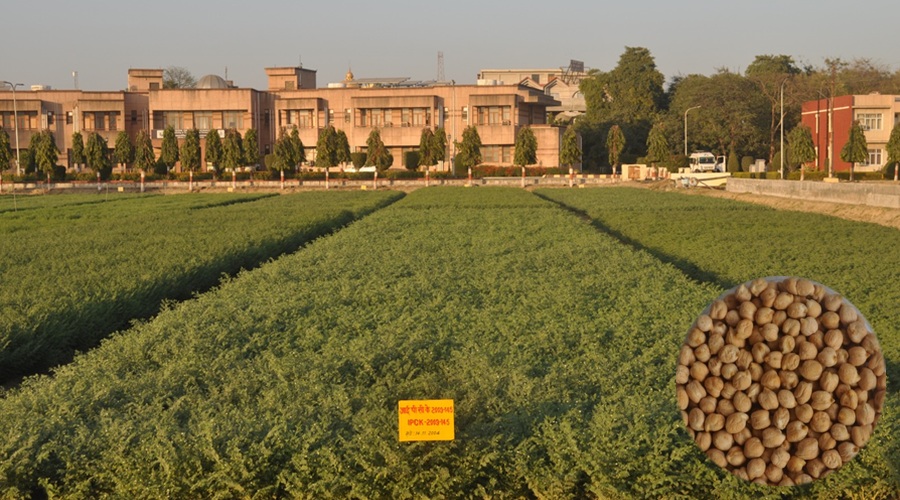 |
| Breeding Method: Hybridization followed by Pedigree Method of Selection | ||
| Institute: ICAR-Indian Institute of Pulses Research, Kanpur | ||
| Seed Yield: 18–20 quintal/ha | ||
| Days to Maturity: 130–135 days | ||
| Disease resistance: Moderately resistant to Fusarium wilt disease | ||
| Seed colour/weight: Seed creamy white colour of Kabuli chickpea variety with large seed size (32.2g/100-seed weight) | ||
| Special Features: Semi-erect growth habit with medium tall height (55.6cm), broad leaf size, light green foliage, tolerance to high temperature | ||
| Ecology: Irrigated, Timely Sown Condition | ||
| Recommended Zone/State: Uttar Pradesh | ||
| Notification: SVRC released with Notification S.O. 1056(E) dated 06.03.2023 | ||
| Developers: Drs. Yogesh Kumar, SK Chaturvedi, B Mondal, AK Srivastava, UC Jha, Archana Singh, Revnappa SB, Manjunath L, KR Soren, GP Dixit, NP Singh, Shiv Sewak, Sh. RKS Yadav, AS Yadav | ||
| IPC 2010-142 (Kuber, Desi Type) (IC No. 645910) | Pedigree: RSG 143-1 / IPC 94-94 | 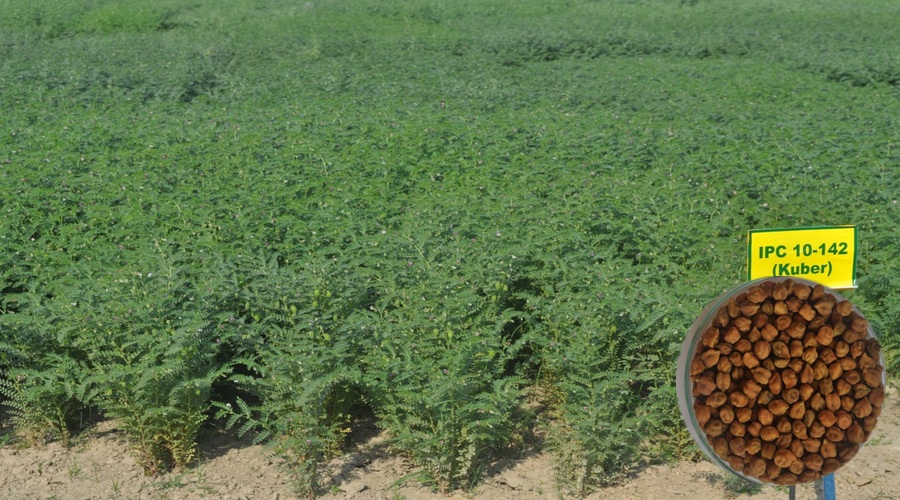 |
| Breeding Method: Hybridization followed by Pedigree Method of Selection | ||
| Institute: ICAR-Indian Institute of Pulses Research, Kanpur | ||
| Seed Yield: 20–22 quintal/ha | ||
| Days to Maturity: 130–140 days | ||
| Disease resistance: Resistant to Fusarium wilt and moderately resistant to DRR, Ascochyta blight and BGM | ||
| Seed colour/weight: Seed brown colour with angular shape and large seed size (29.1g/100-seed weight) | ||
| Special Features: Less incidence to pod borer, semi-erect growth habit with tall plant height, green foliage, tolerance to high temperature | ||
| Ecology: Irrigated, Timely Sown Condition | ||
| Recommended Zone/State: Uttar Pradesh | ||
| Release & notification: SVRC released with Notification No. 1056(E) dated 06.03.2023 | ||
| Developers: Drs. Yogesh Kumar, SK Chaturvedi, B Mondal, AK Srivastava, UC Jha, Archana Singh, Revnappa SB, Manjunath L, KR Soren, GP Dixit, NP Singh, Shiv Sewak, Sh. RKS Yadav, AS Yadav | ||
| IPCB 2015-132 (Kundan, machine harvestable, Desi Type) (IC No. 650473) | Breeding Method/Pedigree: Developed through interspecific hybridization [(GNG1581 (Cicer arietinum)/ILWC21 (Cicer reticulatum)] followed by pedigree selection | 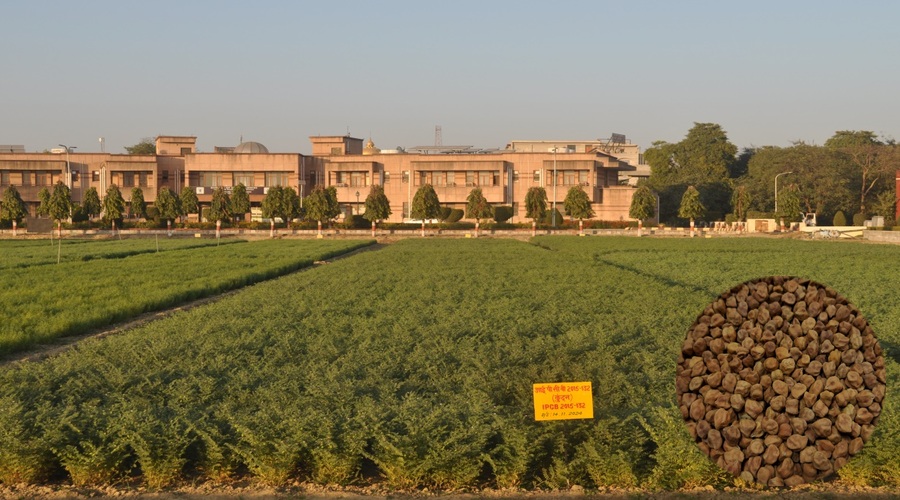 |
| Institute: ICAR-Indian Institute of Pulses Research, Kanpur | ||
| Seed Yield: 22–25 quintal/ha | ||
| Days to Maturity: 125–130 days | ||
| Disease resistance: Resistant to Fusarium wilt and tolerant to DRR, Collar Rot | ||
| Seed colour/weight: Seed brown colour and medium seed size (14.7g/100-seed wt.) | ||
| Seed protein content: 20.25% | ||
| Special Features: Tall plants (>65.0 cm height & first podding height >28cm) with erect growth habit, lodging resistant, suitable for Machine harvest | ||
| Ecology: Irrigated, Timely Sown Condition | ||
| Recommended Zone: North Eastern Plain Zone (NEPZ) comprising of Eastern Uttar Pradesh, Bihar, Jharkhand, West Bengal and Assam | ||
| Release & notification: CVRC released with Notification S.O. 1560(E) dated 26.03.2024 | ||
| Developers: Drs. Yogesh Kumar, SK Chaturvedi, B Mondal, AK Srivastava, UC Jha, Archana Singh, Revnappa SB, Manjunath L, KR Soren, GP Dixit, NP Singh, Shiv Sewak, Sh. RKS Yadav, AS Yadav |
Pigeonpea:
| Crop Name | Features | Image |
|---|---|---|
| IPA 203 (Prakash, Late maturity) | Year of Release: 2015 (CVRC) |  |
| Potential Yield: 25–28 q/ha | ||
| Duration: 249–255 days | ||
| Recommended Area: North East Plain Zone | ||
| Ecology: Timely sown and rainfed | ||
| Special Characters: Resistant to fusarium wilt, light brown colour seed with medium size seed (12–14 g/100-seed) | ||
| IPA 206 (Ganga, Late maturity) | Year of Release: 2020, SVRC (UP) |  |
| Potential Yield: 25–26 q/ha | ||
| Duration: 245–250 days | ||
| Recommended Area: Uttar Pradesh | ||
| Ecology: Timely sown and rainfed | ||
| Special Characters: Resistant to wilt and SMD, purple seed colour with medium size seed (10–11 g/100-seed wt.) | ||
| IPA 15-2 (Sharada, Late maturity) | Year of Release: 2020 (CVRC) |  |
| Potential Yield: 28–33 q/ha | ||
| Duration: 240–255 days | ||
| Recommended Area: North East Plain Zone | ||
| Ecology: Timely sown and rainfed | ||
| Special Characters: Resistant to fusarium wilt and sterility mosaic, brown colour seed with medium size seed (10–12 g/100-seed) | ||
| IPH 15-03 (Hybrid, Early maturity) | Year of Release: 2020 (CVRC) |  |
| Potential Yield: 24–25 q/ha | ||
| Duration: 150–155 days | ||
| Recommended Area: North West Plain Zone | ||
| Ecology: Timely sown and rainfed | ||
| Special Characters: Hybrid variety resistant to wilt, brown seed colour with medium seed size (8–8.54 g/100-seed wt.) | ||
| IPH 9-05 (Hybrid, Early maturity) | Year of Release: 2021 (CVRC) |  |
| Potential Yield: 22–23 q/ha | ||
| Duration: 150–155 days | ||
| Recommended Area: North West Plain Zone | ||
| Ecology: Timely sown and rainfed | ||
| Special Characters: Hybrid variety tolerant to Phytophthora blight, sterility mosaic and moderately resistant to wilt, medium seed size (9–9.6 g/100-seed) | ||
| IPAE 15-6 | Year of Release: 2021 (CVRC) |  |
| Potential Yield: 21–25 q/ha | ||
| Duration: 129–149 days | ||
| Recommended Area: Central Zone | ||
| Ecology: Timely sown and rainfed | ||
| Special Characters: Tolerant to sterility mosaic, phytophthora blight and moderately resistant to wilt, medium brown seed size (9.5–10 g/100-seed) |
Mungbean:
| Crop Name | Features | Image |
|---|---|---|
| PDM 11 | Year of Release: 1987 (CVRC) |  |
| Average Yield: 8–10 q/ha | ||
| Duration: 75 days | ||
| Recommended Area: North East Plain Zone, Central Zone | ||
| Ecology: Spring and Summer season (Timely sown and irrigated) | ||
| Special Characters: Resistant to yellow mosaic disease. Seed shining green in colour and medium-sized (hundred seed weight: 3.2 g). | ||
| PDM 54 (Moti) | Year of Release: 1987 (CVRC) |  |
| Average Yield: 8–10 q/ha | ||
| Duration: 65 days | ||
| Recommended Area: North West Plain Zone, North East Plain Zone | ||
| Ecology: Early maturity, large seeds, multiple disease resistance. | ||
| Special Characters: Seed green in colour and large-sized (hundred seed weight: 4.0 g). | ||
| PDM 139 (Samrat) | Year of Release: 2001, SVRC (UP) |  |
| Average Yield: 10–12 q/ha | ||
| Duration: 58–62 days | ||
| Recommended Area: Uttar Pradesh | ||
| Ecology: Kharif and Spring/Summer season (Timely sown, irrigated and rainfed) | ||
| Special Characters: Early maturity, MYMV resistance, shining green seed (hundred seed weight: 3.8 g). | ||
| IPM 99-125 (Meha) | Year of Release: 2005 (CVRC) |  |
| Average Yield: 12–15 q/ha | ||
| Duration: 65–72 days | ||
| Recommended Area: North East Plain Zone | ||
| Ecology: Spring season (Timely sown, irrigated) | ||
| Special Characters: Early maturity, synchronous flowering, urdbean-type pod clusters, MYMV resistance (hundred seed weight: 3.54 g). | ||
| IPM 02-3 | Year of Release: 2009 (CVRC) |  |
| Average Yield: 12–15 q/ha | ||
| Duration: 65–70 days | ||
| Recommended Area: North West Plain Zone | ||
| Ecology: Kharif and Spring season (Timely sown, irrigated and rainfed) | ||
| Special Characters: Highly resistant to yellow mosaic disease. Photo and thermo-insensitive. Large seeded (hundred seed weight: 3.54 g). | ||
| IPM 2-14 | Year of Release: 2011 (CVRC) |  |
| Average Yield: 12–14 q/ha | ||
| Duration: 62–65 days | ||
| Recommended Area: South Zone | ||
| Ecology: Summer season (Timely sown, irrigated) | ||
| Special Characters: Multiple disease resistance to MYMV and leaf crinkle (hundred seed weight: 3.54 g). | ||
| IPM 205-7 (Virat) | Year of Release: 2016 (CVRC) |  |
| Average Yield: 13–15 q/ha | ||
| Duration: 55 days | ||
| Recommended Area: Karnataka, TN, MP, Gujarat, Rajasthan, Maharashtra, UP | ||
| Ecology: Summer season (Timely sown, irrigated) | ||
| Special Characters: Highly resistant to MYMV, Powdery Mildew and Cercospora Leaf Spot (hundred seed weight: 3.54 g). | ||
| IPM 410-3 (Shikha) | Year of Release: 2016 (CVRC) |  |
| Average Yield: 13–16 q/ha | ||
| Duration: 60–65 days | ||
| Recommended Area: North West Plain Zone, Central Zone | ||
| Ecology: Spring season (Timely sown, irrigated) | ||
| Special Characters: Highly resistant to MYMV and Powdery Mildew; moderately resistant to Cercospora Leaf Spot. Green, shining, and medium-large seeds. | ||
| IPM 2014-9 (Varsha) | Year of Release: 2018, SVRC (UP) |  |
| Potential Yield: 10–12 q/ha | ||
| Duration: 65–75 days | ||
| Recommended Area: Uttar Pradesh | ||
| Ecology: Kharif season (Timely sown, rainfed) | ||
| Special Characters: Highly resistant to MYMV and Powdery Mildew; moderately resistant to Cercospora Leaf Spot. Green, shining, and large seeds. | ||
| IPM 302-2 (Kanika) | Year of Release: 2018, SVRC (UP) |  |
| Potential Yield: 10–12 q/ha | ||
| Duration: 70–75 days | ||
| Recommended Area: Uttar Pradesh | ||
| Ecology: Kharif and Spring season (Timely sown, irrigated and rainfed) | ||
| Special Characters: Highly resistant to MYMV, Powdery Mildew, and leaf curl. Green, shining, and large seeds. | ||
| IPM 312-20 (Vasudha) | Year of Release: 2020, SVRC (UP) |  |
| Potential Yield: 12–14 q/ha | ||
| Duration: 70–80 days | ||
| Recommended Area: Uttar Pradesh | ||
| Ecology: Spring season (Timely sown, irrigated) | ||
| Special Characters: Resistant to YMD, PM, and Cercospora Leaf Spot. Green, shining, and medium-large seeds (hundred seed weight: 3.9 g). | ||
| IPM 409-4 (Heera) | Year of Release: 2020, SVRC (UP) |  |
| Potential Yield: 11–12 q/ha | ||
| Duration: 70–74 days | ||
| Recommended Area: Uttar Pradesh | ||
| Ecology: Spring season (Timely sown, irrigated) | ||
| Special Characters: Resistant to MYMV, Powdery Mildew, and Cercospora Leaf Spot. Green, shining, medium-large seeds (hundred seed weight: 3.5 g). | ||
| IPM 512-1 (Soorya) | Year of Release: 2020 (CVRC) |  |
| Potential Yield: 14–16 q/ha | ||
| Duration: 65–70 days | ||
| Recommended Area: North East Plain Zone | ||
| Ecology: Spring season (Timely sown, irrigated) | ||
| Special Characters: Highly resistant to MYMV, Cercospora Leaf Spot, and anthracnose. Green, shining, and medium-large seeds (hundred seed weight: 3.0 g). |
Urdbean:
| Crop Name | Features | Image |
|---|---|---|
| PDU 1 (Basant Bahar) | Year of Release: 1991 (CVRC) |  |
| Potential Yield: 9–10 q/ha | ||
| Duration: 70–80 days | ||
| Recommended Area: North West Plain Zone, Central Zone | ||
| Ecology: Spring season (Timely sown and irrigated) | ||
| Special Characters: MYMV tolerant, good plant type. Seed black in colour, hundred seed weight: 3.6 g. | ||
| IPU 94-1 (Uttara) | Year of Release: 2000 (CVRC) |  |
| Potential Yield: 12–14 q/ha | ||
| Duration: 80–85 days | ||
| Recommended Area: North West Plain Zone, North East Plain Zone | ||
| Ecology: Kharif season (Timely sown and rainfed) | ||
| Special Characters: MYMV resistant, attractive plant type. Seed black in colour, hundred seed weight: 3.6 g. | ||
| IPU 02-43 | Year of Release: 2009 (CVRC) |  |
| Potential Yield: 10–12 q/ha | ||
| Duration: 70–72 days | ||
| Recommended Area: South Zone | ||
| Ecology: Kharif season (Timely sown and rainfed) | ||
| Special Characters: MYMV and Powdery mildew resistant. | ||
| IPU 11-02 | Year of Release: 2019, SVRC (UP, MP) |  |
| Potential Yield: 10–12 q/ha | ||
| Duration: 80–85 days | ||
| Recommended Area: Madhya Pradesh and Uttar Pradesh | ||
| Ecology: Kharif season (Timely sown and rainfed) | ||
| Special Characters: Dull black colour with medium large seed (4.3 g/100 seed wt.) and high protein content (26%), resistant to MYMV, ULCV, PM, anthracnose and Cercospora leaf spot. | ||
| IPU 10-26 | Year of Release: 2020, SVRC (MP) |  |
| Potential Yield: 10–12 q/ha | ||
| Duration: 70–75 days | ||
| Recommended Area: Madhya Pradesh | ||
| Ecology: Kharif season (Timely sown and rainfed) | ||
| Special Characters: Shining black seed colour, medium large seed (3.82 g/100 seed wt.) with high protein content (25%), highly resistant to MYMV, Cercospora leaf spots and resistant to ULCV, stem necrosis, web blight, BLB, anthracnose, PM. | ||
| IPU 13-1 | Year of Release: 2020, SVRC (UP, MP) |

|
| Potential Yield: 10–12 q/ha | ||
| Duration: 70–75 days | ||
| Recommended Areas: Madhya Pradesh and Uttar Pradesh | ||
| Ecology: Kharif season (Timely sown and rainfed) | ||
| Special Characters: Dull black seed colour, medium large seed (4.14 g/100 seed wt.) with high protein content (26%), resistant to MYMV, Cercospora leaf spots, ULCV, stem necrosis, web blight, BLB, anthracnose and PM. | ||
| IPU 17-1 | Year of Release: 2021, SVRC (MP) |

|
| Potential Yield: 10–12 q/ha | ||
| Duration: 73–74 days | ||
| Recommended Areas: Madhya Pradesh | ||
| Ecology: Kharif season (Timely sown and rainfed) | ||
| Special Characters: Black seed colour (3.35 g/100 seed wt.), resistant to MYMV, Cercospora leaf spots, ULCV, web blight, BLB, PM. Tolerant to drought stress condition. | ||
| IPU 19-10 (Narmada) | Year of Release: 2023, SVRC (MP) |

|
| Potential Yield: 12–14 q/ha | ||
| Duration: 74 days | ||
| Recommended Areas: Madhya Pradesh | ||
| Ecology: Spring season (Timely sown and irrigated) | ||
| Special Characters: Attractive black seed colour (4.8 g/100 seed wt.), resistant to MYMV, ULCV, leaf curl virus, web blight, BLB, PM and Cercospora leaf spot (CLS). | ||
| IPU 17-2 (Dristi) | Year of Release: 2023, SVRC (MP) |

|
| Potential Yield: 10–13 q/ha | ||
| Duration: 73 days | ||
| Recommended Areas: Madhya Pradesh | ||
| Ecology: Spring season (Timely sown and irrigated) | ||
| Special Characters: Black seed colour (4.9 g/100 seed wt.), highly resistant to MYMV, and resistant to ULCV, leaf curl virus, web blight, BLB, PM and CLS. | ||
| IPU 13-6 (Tapti) | Year of Release: 2025 (SVRC, MP) |

|
| Potential Yield: 15–16 q/ha | ||
| Duration: 75 days | ||
| Recommended Areas: Madhya Pradesh | ||
| Ecology: Spring season (Timely sown and irrigated) | ||
| Special Characters: Resistant to yellow mosaic virus, Cercospora leaf spot, leaf crinkle, leaf curl virus, powdery mildew, bacterial leaf blight and web blight. Attractive black seed, medium large seeds (4.50 g/100 seeds). Tolerant to drought stress conditions. |
Lentil:
| Crop Name | Features | Image |
|---|---|---|
| DPL 15 (Priya) | Year of Release: 1995 (CVRC) |  |
| Potential Yield: 15-16 q/ha | ||
| Duration:135-140 days | ||
| Recommended Area: North West Plain Zone | ||
| Ecology: Rabi season (Timely sown and rainfed) | ||
| Special Characters:Resistant to rust and tolerance to wilt. Seed brown in colour, medium-sized (2.7 g/100 seed wt.) with orange cotyledons. | ||
| DPL 62 (Sheri) | Year of Release: 1997 (CVRC) |  |
| Potential Yield:17-18 q/ha | ||
| Duration:130-135 days | ||
| Recommended Area: North West Plain Zone | ||
| Ecology: Rabi season (Timely sown and rainfed) /td> | ||
| Special Characters:Resistant to rust and tolerance to wilt. Large seeded (3.1 g/100 seed wt.) with mottled seed coat and red cotyledons. Wider adaptability, high protein content (25.2%), broad non-tendril leaflets. | ||
| IPL 81 (Noori) | Year of Release: 2001 (CVRC) |  |
| Potential Yield:12-14 q/ha | ||
| Duration:110-115 days | ||
| Recommended Area:Central Zone | ||
| Ecology: Rabi season (Timely sown and rainfed) | ||
| Special Characters:Tolerant to rust and wilt. Grey mottled seed coat and medium-sized seeds (2.7 g/100 seed wt.) | ||
| IPL 406 (Angoori | Year of Release: 2007 (CVRC) |  |
| Potential Yield:17-18 q/ha | ||
| Duration: 125-130 days | ||
| Recommended Area:North West Plain Zone | ||
| Ecology: Rabi season (Timely sown and rainfed) | ||
| Special Characters:Tolerant to rust and wilt, extra-large seeds (3.93 g/100 seed wt.) with pink cotyledons. | ||
| IPL 316 | Year of Release:2013 (CVRC) |  |
| Potential Yield: 18-20 q/ha | ||
| Duration:102-112 days | ||
| Recommended Area:Central Zone | ||
| Ecology: Rabi season (Timely sown and rainfed) | ||
| Special Characters:Resistance to wilt and rust. Seed brown with red cotyledons and large (3.1g/100 seed wt.) | ||
| IPL 526 | Year of Release:2016, SVRC (UP) |  |
| Potential Yield: 10-15 q/ha | ||
| Duration:105-112 days | ||
| Recommended Area: Uttar Pradesh | ||
| Ecology: Rabi season (Timely sown and rainfed) | ||
| Special Characters:Tolerance to wilt and rust diseases, seed attractive with large size (3.0 g/100 seed wt.), grey dotted seed coat and red cotyledons. Early in maturity | ||
| IPL 220 (Biofortified variety) | Year of Release:2018 (CVRC) |  |
| Potential Yield: 15-20 q/ha | ||
| Duration:120-125 days | ||
| Recommended Area:North East Plain Zone | ||
| Ecology: Rabi season (Timely sown and rainfed) | ||
| Special Characters:Resistance to rust, wilt and stemphylium blight, brown seed coat with orange cotyledon and small seeded (2.4g/100 seed wt), high Zn& Fe content | ||
| IPL 321 | Year of Release:2019, SVRC (UP) |  |
| Potential Yield:12-14 q/ha | ||
| Duration:125-135 days | ||
| Recommended Area:Uttar Pradesh | ||
| Ecology: Rabi season (Timely sown and rainfed) | ||
| Special Characters:Highly resistant to rust and Fusarium wilt, brown and dotted seed coat, red cotyledons and large seeded (3.0 g/ 100 seed wt.) | ||
| IPL 315 | Year of Release:2019, SVRC (UP) |  |
| Potential Yield: 15-20 q/ha | ||
| Duration:129-138 days | ||
| Recommended Area: Uttar Pradesh | ||
| Ecology: Rabi season (Timely sown and rainfed) | ||
| Special Characters:Resistant to rust and tolerant to wilt. Seed brown colour with orange cotyledons and large size (2.9 g/100 seed-weight) | ||
| IPL 534 | Year of Release:2020, SVRC (MP) |  |
| Potential Yield: 14-16 q/ha | ||
| Duration:100-107 days | ||
| Recommended Area: Madhya Pradesh | ||
| Ecology: Rabi season (Timely sown and rainfed) | ||
| Special Characters:Early maturing, Resistance to rust, wilt and stem phylium blight. Seed brown with red cotyledons and large size (3.2g/100 seed wt.) | ||
| IPL 225 | Year of Release:2021, SVRC (UP) |  |
| Potential Yield: 12-14 q/ha | ||
| Duration:105-133 days | ||
| Recommended Area: Uttar Pradesh | ||
| Ecology: Rabi season (Timely sown and rainfed) | ||
| Special Characters:Highly resistance to rust and wilt diseases and small seeded (2.1 g/100 seeds), brown dotted seed coat and red cotyledons | ||
| IPL 329 | Year of Release:2021, SVRC (UP) |  |
| Potential Yield:12-14 q/ha | ||
| Duration:115-134 days | ||
| Recommended Area: Uttar Pradesh | ||
| Ecology: Rabi season (Timely sown and rainfed) | ||
| Special Characters:Resistance to rust and wilt diseases and large seeds (2.9g/100 seeds) with brown dotted seed coat and red cotyledons | ||
| IPL 230 | Year of Release: 2023, SVRC (UP) |  |
| Potential Yield: 13 q/ha | ||
| Duration: 111–126 days | ||
| Recommended Areas: Uttar Pradesh | ||
| Ecology: Rabi season (Timely sown and rainfed) | ||
| Special Characters: Resistance to rust, Stemphylium blight and wilt diseases, small-seeded (2.6 g/100 seeds) with tan dotted and lens-shaped seed coat and red cotyledons. | ||
| IPL 341 (Jagrati) | Year of Release: 2025 (SVRC, MP) |  |
| Potential Yield: 18–20 q/ha | ||
| Duration: 111 days | ||
| Recommended Areas: Madhya Pradesh | ||
| Ecology: Rabi season (Timely sown and rainfed) | ||
| Special Characters: Resistant to major diseases including rust and Fusarium wilt. Large-seeded (100 seed weight: 3.0 g) with brown seed coat and red cotyledons. | ||
| IPL 342 (Uttam) | Year of Release: 2025 (SVRC, MP) |  |
| Potential Yield: 18–20 q/ha | ||
| Duration: 112 days | ||
| Recommended Areas: Madhya Pradesh | ||
| Ecology: Rabi season (Timely sown and rainfed) | ||
| Special Characters: Resistant to major diseases including rust and Fusarium wilt. Large-seeded (3.2 g/100 seeds) variety with red cotyledons. |
Fieldpea
| Crop Name | Features | Image |
|---|---|---|
| IPF 99-25 (Adarsh) | Year of Release:2004 (CVRC) |  |
| Potential Yield: 23-24 q/ha | ||
| Duration:110-115 days | ||
| Recommended Area: Central Zone | ||
| Ecology: Rabi season (Timely sown, Irrigated and Rainfed) | ||
| Special Characters:Tall, resistant to powdery mildew, white seeded and HSW: 18.4 g | ||
| IPFD 99-13 (Vikas) | Year of Release: 2005 (CVRC) |  |
| Potential Yield:22-25 q/ha | ||
| Duration:100-105 days | ||
| Recommended Area: Central Zone | ||
| Ecology: Rabi season (Timely sown, Irrigated and Rainfed) | ||
| Special Characters:Dwarf, resistant to powdery mildew, white seeded and HSW: 19.1 g | ||
| IPFD 01-10 (Prakash) | Year of Release: 2006 (CVRC) |  |
| Potential Yield:22-25 q/ha | ||
| Duration:110-115 days | ||
| Recommended Area:Central Zone, North Hill Zone | ||
| Ecology: Rabi season (Timely sown, Irrigated and Rainfed) | ||
| Special Characters:Dwarf, resistant to powdery mildew, white seeded and HSW: 22.10 g | ||
| IPF 05-19 (Aman) | Year of Release: 2010 (CVRC) |  |
| Potential Yield:22-25 q/ha | ||
| Duration: 120-130 days | ||
| Recommended Area:North West Plain Zone | ||
| Ecology: Rabi season (Timely sown, Irrigated and Rainfed) | ||
| Special Characters:Tall, resistant to powdery mildew, white seeded and HSW: 22.10 g | ||
| IPF 04-9 | Year of Release:2011, SVRC (UP) |  |
| Potential Yield: 18-20 q/ha | ||
| Duration:125-130 days | ||
| Recommended Area:Uttar Pradesh | ||
| Ecology: Rabi season (Timely sown, Irrigated and Rainfed) | ||
| Special Characters:Tall, resistant to powdery mildew, white seeded | ||
| IPFD 10-12 (Green seed) | Year of Release:2014 (CVRC) |  |
| Potential Yield:21-22 q/ha | ||
| Duration:110-115 days | ||
| Recommended Area: Central Zone | ||
| Ecology: Rabi season (Timely sown, Irrigated and Rainfed) | ||
| Special Characters:Dwarf, resistant to powdery mildew, green seeded and HSW: 16.4 g | ||
| IPFD 11-5 | Year of Release:2016 (CVRC) |  |
| Potential Yield: 22-23 q/ha | ||
| Duration:105-110 days | ||
| Recommended Area:Central Zone | ||
| Ecology: Rabi season (Timely sown, Irrigated and Rainfed) | ||
| Special Characters:Dwarf, resistant to powdery mildew disease and moderately tolerant to pod borer, seed creamy white and round, HSW: 16.20 g. Protein content: 22.98% | ||
| IPFD 6-3 | Year of Release:2016, SVRC (UP) |  |
| Potential Yield:19-20 q/ha | ||
| Duration:115-120 days | ||
| Recommended Area:Uttar Pradesh | ||
| Ecology: Rabi season (Timely sown, Irrigated and Rainfed) | ||
| Special Characters:Dwarf, resistant to powdery mildew, tolerant to rust, seed creamy white and round, HSW: 19.60 g. Protein content: 24.06% | ||
| IPFD 12-2 | Year of Release:2017 (CVRC) |  |
| Potential Yield: 22-25 q/ha | ||
| Duration:110 days | ||
| Recommended Area: Central Zone, | ||
| Ecology: Rabi season (Timely sown, Irrigated and Rainfed) | ||
| Special Characters:Dwarf, resistant to powdery mildew disease, pod borer and moderately resistant to aphids and leaf-miner, seed white and round, HSW: 16.93 g. Protein content: 23.05% | ||
| IPFD 14-2 | Year of Release:2018 (CVRC) |  |
| Potential Yield: 22-23 q/ha | ||
| Duration:105-110 days | ||
| Recommended Area:Central Zone | ||
| Ecology: Rabi season (Timely sown, Irrigated and Rainfed) | ||
| Special Characters:Dwarf, resistant to powdery mildew, mottled tan coloured seed, HSW: 18.66 g. Protein content: 25.15% | ||
| IPF 16-13 (Harit, Green seed) | Year of Release:2020 (CVRC) |  |
| Potential Yield:18-20 q/ha | ||
| Duration:115-120 days | ||
| Recommended Area: NEPZ | ||
| Ecology: Rabi season (Timely sown, Irrigated and Rainfed) | ||
| Special Characters:Round and green seeded variety with resistant to powdery mildew disease, HSW: 19.0 g. Protein content: 21.44% | ||
| IPFD 9-2 | Year of Release:2019, SVRC (UP) |  |
| Potential Yield:20-22 q/ha | ||
| Duration:125-130 days | ||
| Recommended Area: Uttar Pradesh | ||
| Ecology: Rabi season (Timely sown, Irrigated and Rainfed) | ||
| Special Characters:Round and creamish white colour seed variety with resistant to powdery mildew disease, HSW: 17.80 g. Protein content: 24.54% | ||
| IPFD 12-8 (Aakash) | Year of Release:2020, SVRC (UP) |  |
| Potential Yield:20-22 q/ha | ||
| Duration:120-130 days | ||
| Recommended Area: Uttar Pradesh | ||
| Ecology: Rabi season (Timely sown, Irrigated and Rainfed) | ||
| Special Characters:Resistant to powdery mildew and rust disease, dwarf and leafy type with medium creamish white round seed, HSW: 18.0 g. | ||
| IPFD 13-2 (Anant) | Year of Release:2020, SVRC (UP) |  |
| Potential Yield:20-22 q/ha | ||
| Duration:115-125 days | ||
| Recommended Area: Uttar Pradesh | ||
| Ecology: Rabi season (Timely sown, Irrigated and Rainfed) | ||
| Special Characters:Resistant to powdery, Downey mildew and rust disease, medium seed size with round, smooth and white seed colour, HSW: 18.20 g | ||
| IPFD 16-3 | Year of Release: 2021, SVRC (UP) |  |
| Potential Yield: 17–18 q/ha | ||
| Duration: 115–125 days | ||
| Recommended Areas: Uttar Pradesh | ||
| Ecology: Rabi season (Timely sown, Irrigated and Rainfed) | ||
| Special Characters: Resistant to powdery mildew, rust and Ascochyta blight; seed creamish white; HSW: 16–19 g. | ||
| IPFD 19-1 (Shikhar) | Year of Release: 2023, CVRC |  |
| Potential Yield: 19–20 q/ha | ||
| Duration: 120–125 days | ||
| Recommended Areas: NEPZ | ||
| Ecology: Rabi season (Timely sown, Irrigated and Rainfed) | ||
| Special Characters: Resistant to powdery mildew and rust; seed creamish white; HSW: 18 g; Protein content: 20–24%. | ||
| IPFD 19-3 (Arpan) | Year of Release: 2023, CVRC |  |
| Potential Yield: 17–18 q/ha | ||
| Duration: 120–125 days | ||
| Recommended Areas: NEPZ | ||
| Ecology: Rabi season (Timely sown, Irrigated and Rainfed) | ||
| Special Characters: Resistant to powdery mildew, rust and Ascochyta blight; seed creamish white; HSW: 18.55 g; Protein content: 20–22%. | ||
| IPFD 18-3 (Purvansh) | Year of Release: 2025, CVRC |  |
| Potential Yield: 19–20 q/ha | ||
| Duration: 117 days | ||
| Recommended Areas: NEPZ | ||
| Ecology: Rabi season (Timely sown, Irrigated and Rainfed) | ||
| Special Characters: Resistant to powdery mildew and Ascochyta blight. Dwarf and leafy type with green stipule, slightly dimpled & creamy white colour seeds with medium size (18.0 g). High protein content (25.7%). |
Rajmash
| Crop Name | Features | Image |
|---|---|---|
| PDR 14 (Uday) | Year of Release: 1991 (CVRC) |  |
| Potential Yield: 20-22 q/ha | ||
| Duration:125-130 days | ||
| Recommended Area: North East Plain Zone | ||
| Special Characters:Tolerance to BCMV and variegated red seeds | ||
| IPR 96-4 (Amber) | Year of Release: 2002 (CVRC) |  |
| Potential Yield:20-24 q/ha | ||
| Duration:139-145 days | ||
| Recommended Area:North East Plain Zone | ||
| Special Characters:Resistant to BCMV & leaf crinckle | ||
| IPR 98-5 (Utkarsh) | Year of Release: 2005 (CVRC) |  |
| Potential Yield:24-25 q/ha | ||
| Duration:122-125 days | ||
| Recommended Area:North East Plain Zone | ||
| Special Characters:Tolerance to BCMV, Cold tolerance, attractive seed colour | ||
| IPR 98-3-1 (Arun) | Year of Release: 2007 |  |
| Potential Yield:24-25 q/ha | ||
| Duration: 120-125 days | ||
| Recommended Area:Central Zone | ||
| Special Characters:Tolerance to BCMV, attractive dark red medium seeds |
Genetic stocks/ Donors registered
| Crops | Genetic Stock/ Donor/ population | Trait for which registered |
|---|---|---|
| Chickpea | ICC 12315 (INGR 21142) | Post emergence herbicide tolerance (Imazethapyr) |
| IPC 2020-198 (INGR 21141) | > 2 seeds per pod in ≥30% pods per plant (mean seeds per pod = 2.62) | |
| ICC 15925 (INGR 21144) | Heat tolerance | |
| IPC 2010-121 (INGR 20077) | Resistant breeding line against Race-2 of Fusarium oxysporumf. sp.ciceris. Desi type of chickpea | |
| NIL VC 35/5-4 (INGR22153) | Highly resistant NIL against Fusarium wilt caused by Fusarium oxysporum f.sp. ciceri, race 2 (Foc 2), developed through MABC approach. High yield and wider adaptability. | |
| Pigeonpea | IPAC 79 (INGR 20023) | Tolerance to waterlogging stress. |
| IPAV 16-1 (INGR 20025) | Wilt resistance and extra large seed size | |
| IPA Cleisto 10 | Closed flower structure until complete fertilization. Independent anther filaments (Absence of diadelphous condition). Indeterminate high yielding genetic background. | |
| ICPL 88039A & ICPL 88039B (INGR 23047) | Cytoplasmic Male Sterility. A2 Cytoplasmic source. Early maturing (140-150 days). | |
| Urdbean | IPU19-27 (registered line) | Early maturity, suitable for high rainfall areas, suitable for spring/summer/kharif | IPU99-43 (INGR23091) | High seed iron (162 mg/kg) concentration. | HPU120S (INGR23092) | High seed Zinc concentration (54 mg/kg) | IPU 99-167m (INGR12005) | Spontaneously occurring functionally male sterile mutant which produces flower with a protruded stigma and crumpled petals | SPS 5 (INGR 12006) | Sympodial pod bearing habit |
| Mung bean | IPM 205-7 (INGR11044) | Extra early maturing genotype (52-55 days) |
| IPM 409-4 INGR11043 | Extra early maturing genotype (52-55 days) | |
| IPM604-1-7 (INGR21104) | Yellow seed coat colour, early maturity | |
| V. glabrescens (INGR21143) | Photo- and thermo period insensitive | |
| V. umbellata (INGR21226) | Photo- and thermo period insensitive | |
| V. vexillata (INGR22039) | Resistant against Callosobruchus maculatus | |
| V. umbellata (INGR22041) | Resistant against Callosobruchus maculatus | |
| IPM 526-11(INGR22046) | Highly resistant to yellow mosaic disease caused by Mungbean yellow mosaic India virus | |
| V. stipulaceae (INGR22040) | Early flowering (20DAS) and early maturity (49DAS) | |
| Fieldpea | P-637 (INGR19075) | Post emergence herbicide (Metribuzin) tolerant genotype |
| IPFD 18-14(INGR21140) | Extra early genotype that matures in less than 85 days | |
| IPF 2014-13 (INGR21227) | Resistant to rust | |
| IPF 2014-16(INGR 22043) | Resistant to rust | |
| IPFD 18-26(INGR 22044) | Dwarf, green seeded and extra early genotype | |
| EC 564816(INGR 22045) | Intact/extended funiculus accession | |
| IPF 2021-21 (INGR24026) | Acacia type leaf pattern. | |
| Rajmash | IC360831 (INGR21136) | Highly Resistant to BCMV disease, High grain yield |
| IC340947 (INGR21103) | Highly Resistant to BCMV disease, High grain yield | |
| Cowpea | EC 762384 (INGR21222) | Dense pubescence |
| Lentil | ILWLS 118 (INGR240426) | Early flowering (30-40 days). Early maturity(80-92 days). |
Plant genetic resources:
Maintenance of wild species
A pre-breeding garden was established at IIPR for maintenance and utilization of genetic diversity contained in wild species of different pulse crops. The wild accessions maintained at IIPR’s pre-breeding garden include 126 accessions of chickpea (Cicer. pinnatifidum, C judaicum, echinospermum, C. reticulatum, C. chorassanicum, C. bijugum and C. cuneatum); 121 wild accessions of lentil belonging to 5 species/subspecies (Lens nigricans: 7 acc., L. culinaris ssp. orientalis : 78 acc. , L. culinaris ssp. tomentosus: 1 acc., L. culinaris ssp. odemensis: 13 acc., and L. ervoides: 13 acc.). In pigeonpea, 108 accessions are being maintained, which belong to Cajanus scarabaeoides, Cajanus cajanifolius, Cajanus lineatus, Cajanus sericeus, Cajanus albicans, Cajanus crassus, Cajanus platycarpus and Cajanus mollis besides 31 accessions of Rhynchosia and Flemingia species. Likewise, 57 wild accessions of Vigna (V. delzelliana: 5 acc., V. glabrescens: 1 acc.,V. glabrescens: 1 acc., V. hainiana: 5 acc., V. mungo var. mungo: 5 acc., V. mungo var. sylvestris: 5 acc., V. pilosa: 3 acc., V. radiata var. radiate: 5 acc., V. radiata var. setulosa: 2 acc., V. radiata var. sublobata: 3 acc., V. trilobata: 8 acc.,V. umbellate: 10 acc., V. unguiculata: 1 acc., V. vexillata: 2 acc. and V. trinervia: 2 acc.) have been collected and procured from Western Ghats and NBPGR, New Delhi, respectively are being maintained.
Infrastructure:
National Active Germplasm site
IIPR is also maintaining more than 10 thousand accessions of mandated crops in medium term cold module (4°C with relative humidity 40 %). These accessions can be maintained for 4-5 years under controlled condition without losing the viability of the materials. As a routine activity regular rejuvenation of these accessions are being carried out time to time. Our active collection with valuable germplasm is available for research purpose to all in the country as and when indented through a standard MTA for use.


Molecular breeding laboratory
The Division has excellent facilities for fundamental research on multi-omics science, genomics-assisted breeding and plant phenotyping. This comprises well equipped laboratories, medium-term cold modules, rainout shelters, glasshouses, environmental controlled chambers, and net houses. The laboratories have the latest equipment like Thermal Cycler, Gel Documentation system, Advanced Research Microscope, Spectrophotometer, Ultra Centrifuge, etc.

Highthroughput hybridization facility
The Division has an excellent highthroughput hybridization facility to allow hybridization work throughout the year (regardless of crop season) under controlled conditions. This facility is especially suitable for short-statured crops such as mungbean, urdbean, chickpea and lentil.
Solar Bubble dryers
The division has eight solar bubble dryers which are of tremendous importance for drying of bulk harvested seeds to bring their moisture content to safe storage levels. This facility is especially important for kharif season when the ambient moisture content is usually very high and pulses such as mungbean, urdbean and pigeonpea can be dried in a much faster way using solar bubble dryers.
Quality Seed Production
Institute is providing nucleus seed of high yielding varities of different pulse crops to ensure genetic purity. More than 650 quintals of breeder seed of six crops (chickpea, pigeon pea, mungbean, urdbean lentil and fieldpea) is being produced annually.
Scientists and their area of specialization


Scientists and their area of specialization


