
Policy
Analysis and market intelligence to guide pulse-sector planning and investment — trade dynamics, price behaviour, policy simulation under supply volatility, and the valuation of what pulse-based systems return to the land.
Policy, Analytics, Capacity building and Extension — the programme that turns research into decisions, and decisions into practice on the farm.
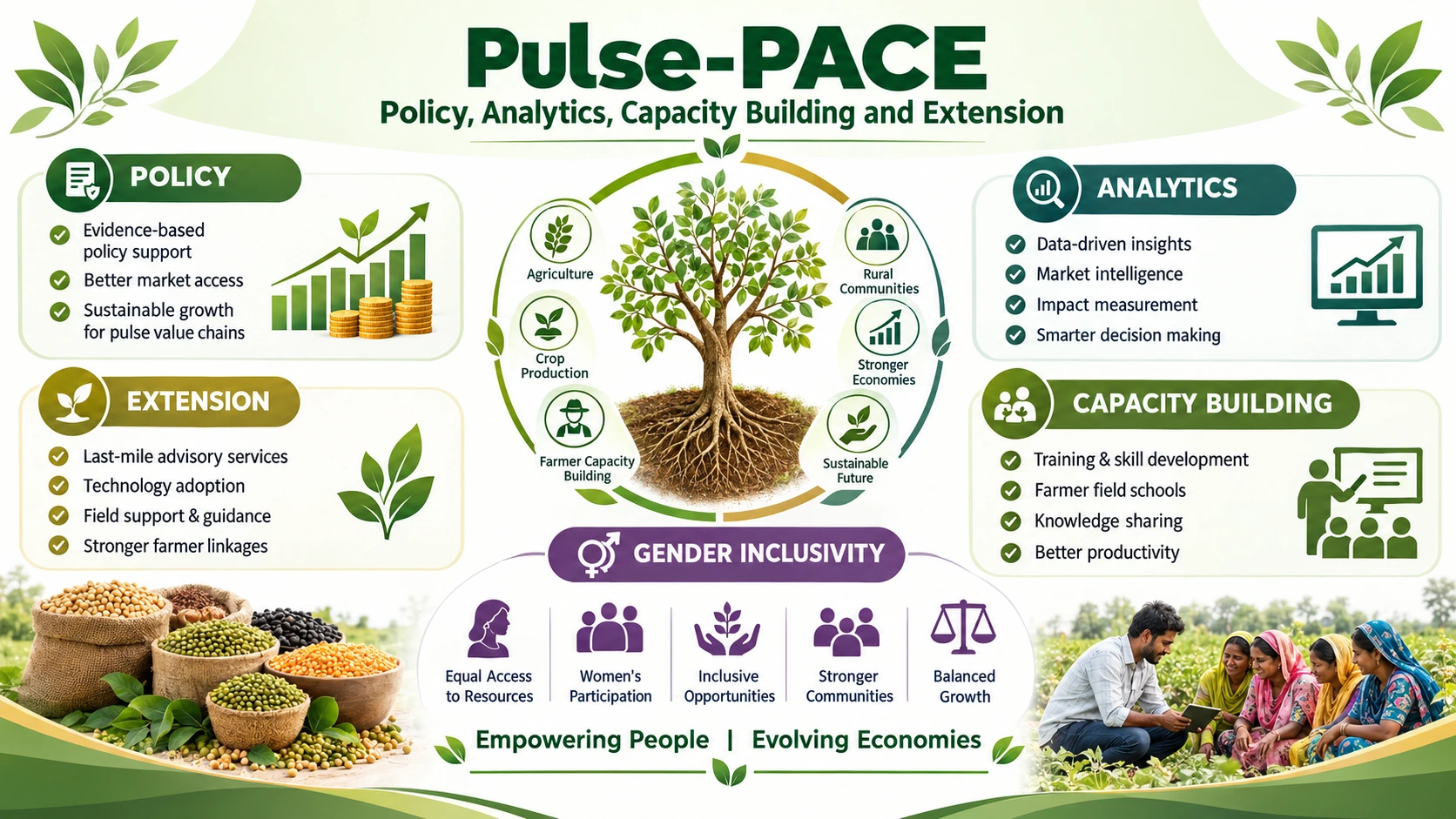
A variety that stays in the research station changes nothing. Pulse-PACE is the programme that closes the distance — measuring what technology is worth, advising the policy that shapes the sector, building the capability of the people in it, and carrying validated practice to the field at scale.
It also runs in the other direction. Farmers’ perspectives, adoption data and market signals come back through the same channels and become the evidence that sets the next research agenda.
Analysis and market intelligence to guide pulse-sector planning and investment — trade dynamics, price behaviour, policy simulation under supply volatility, and the valuation of what pulse-based systems return to the land.
Production, price and adoption data turned into evidence — forecasting models, impact assessment of released varieties and programmes, and machine-learning tools built on the institute’s databases.
Strengthening the capabilities of everyone along the value chain — farmers, extension staff, students and processors — through training, e-learning and farmer producer organisation models.
Carrying validated technology to farm level at scale, through demonstrations, campaigns, digital advisory platforms and the institute’s network of extension models.
Policy analysis and market intelligence to guide pulse-sector planning and investment
Data analytics on production, prices and technology adoption to inform decision-making
Capacity building of farmers, extension staff and stakeholders across the value chain
Rural extension models that carry validated technology to farm level at scale
Assessment of India’s pulse sector using market-based policy simulation under supply volatility, and analysis of production, consumption, market pricing trends and trade dynamics — the evidence base that sector planning and investment decisions rest on.
What a released variety is actually worth once it reaches farmers: yield advantage over the check, area covered, additional production and the value of it. The institute maintains variety-by-variety impact assessments alongside economic assessments of the national pulse promotion programmes.
Forecasting models for production, price and demand, together with newer analytical work — machine learning based prediction tools and AI-based disease diagnostics and advisory for chickpea, pigeonpea, greengram and blackgram.
Web-based databases and information systems on pulse crops, including the e-Dalhan Gyan Manch portal and the library of e-learning video modules that carry pulse production technology in five languages.
Training of farmers, extension staff and stakeholders across the pulse value chain, and the development of an FPO-driven technology delivery model that puts farmer organisations at the centre of dissemination.
Innovative extension models for disseminating pulse production technology, delivered through front-line demonstrations, the farming system approach, Tribal and Scheduled Caste Sub Plan programmes, and national campaigns run in partnership with KVKs and state departments.
Figures published by the Division of Social Sciences, which carries most of the capacity-building and extension work.
2.84 lakh
Users of the e-Dalhan Gyan Manch portal
150
e-Learning video modules in five languages
3,274
Demonstrations under the farming system approach
9,388
Tribal Sub Plan demonstrations, 2021–26